
Appliance Disposal

Washing machine and dryer removal

Washing machines, tumble dryers and washer dryers disconnected, drained, carried out and recycled at a licensed WEEE site. Typical UK prices.

In short: Washing machine and dryer removal covers disconnecting the appliance from its water and waste pipes, draining it, carrying it out and taking it to a licensed WEEE recycling site. It suits anyone replacing or clearing a washer, dryer or washer dryer. In the UK it usually costs £30 to £70 for a single machine.

Get a free quote

Fixed price, no obligation. We aim to reply the same day.

By sending this form you agree to be contacted about your enquiry. See our privacy policy.

Washing machine and dryer removal

A washing machine weighs 60 to 80 kg, mostly because of the concrete counterweights that stop the drum shaking. That makes it awkward to get out of a tight kitchen or down a flight of stairs, and it usually still has water sitting in the pump and hoses. Disconnecting it badly is the usual cause of flooded floors on the day an old machine leaves.

We turn off the cold-fill valve, disconnect the inlet hose, unhook the waste pipe from the standpipe or trap, drain the residual water and cap the open fittings so the kitchen is left dry. Vented and condenser dryers are unplugged and the vent hose or water container dealt with. The machine is recycled at a licensed WEEE site, where the steel, motor and circuit boards are recovered.

What is included

  • Turning off the cold-fill isolation valve and disconnecting the inlet hose
  • Unhooking the waste hose from the standpipe or sink trap
  • Draining residual water from the pump and hoses
  • Capping or blanking open fittings where a cap is available
  • Pulling the machine out from under the worktop without damaging the floor
  • Removing a vented dryer's flexible hose with the machine
  • Carry-out, transport and recycling at a licensed WEEE site
  • Waste transfer note

Who it is for

  • Households whose new machine is arriving without a take-back slot
  • Machines that have broken down with a full drum of water
  • Upstairs flats and properties with tight stairs
  • Landlords swapping out a failed washer between or during tenancies
  • Utility room or kitchen refits

How much does it cost?

As a guide, removing and recycling a single washing machine, dryer or washer dryer usually costs £30 to £70, with a second machine in the same visit usually adding less than the first. See our full cost guide.
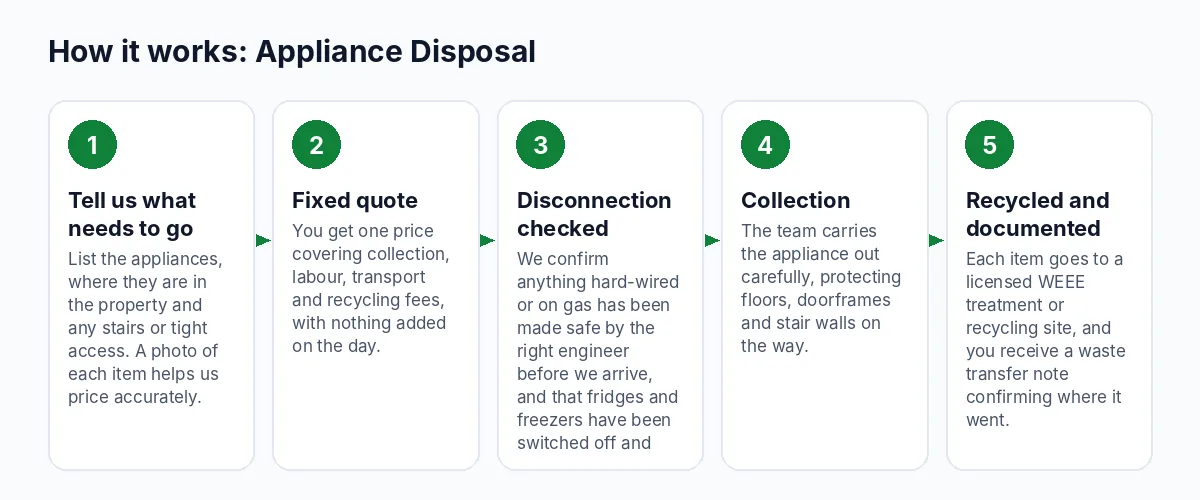
How it works

How washing machine and dryer removal works, step by step
  1. Check the valves

    Look under the sink or behind the machine for the isolation valve, usually a small lever or slotted screw on the cold supply pipe, and make sure it turns.

  2. Disconnect and drain

    On the day the supply is turned off, hoses are removed and the remaining water is drained into a bucket or tray.

  3. Seal and protect

    Open pipework is capped where possible, and the floor and worktop edges are protected while the machine is slid out.

  4. Carry out and recycle

    The machine is carried or trolleyed to the vehicle and taken to a licensed WEEE recycling site.

Washing machine and dryer removal: FAQs

What if the isolation valve will not turn off?

Old valves often seize. If the valve will not close, the water may need to be turned off at the main stopcock while the hose is removed, and a plumber may need to fit a new valve before your new machine goes in. Let us know in advance if you suspect the valve is stuck so it can be planned for.

My washing machine is full of water. Can you still take it?

Yes. A machine that has stopped mid-cycle can be drained through the filter flap at the bottom front, which usually has a small drain hose. It can take a few bucketfuls and a lot of towels. If you can, drain it the day before; if not, it can be done on the day, but tell us so extra time is allowed.

Do you need to fit transit bolts?

No. Transit bolts protect the drum when a working machine is being moved for reuse. A machine going for recycling does not need them. If you are selling or donating a working machine, find the bolts if you still have them, because the buyer or charity may ask for them.

Can you take a gas tumble dryer?

Gas tumble dryers are uncommon but do exist. By law any gas appliance must be disconnected and the supply capped by a Gas Safe registered engineer. Once that has been done, the dryer can be collected and recycled in the same way as an electric one.

Get a quote for washing machine and dryer removal

Send a few details and get one clear, fixed price, usually the same day.

Get a quote

Last updated 6 November 2026